Error event condition management
This screen is used to manage event conditions in order to control transactions or receive notifications when an error that satisfies specific conditions occurs. When conditions, targets, error codes, control methods, and so on are configured in Error event condition management, you can view statistical information about error events on the error monitoring screen.
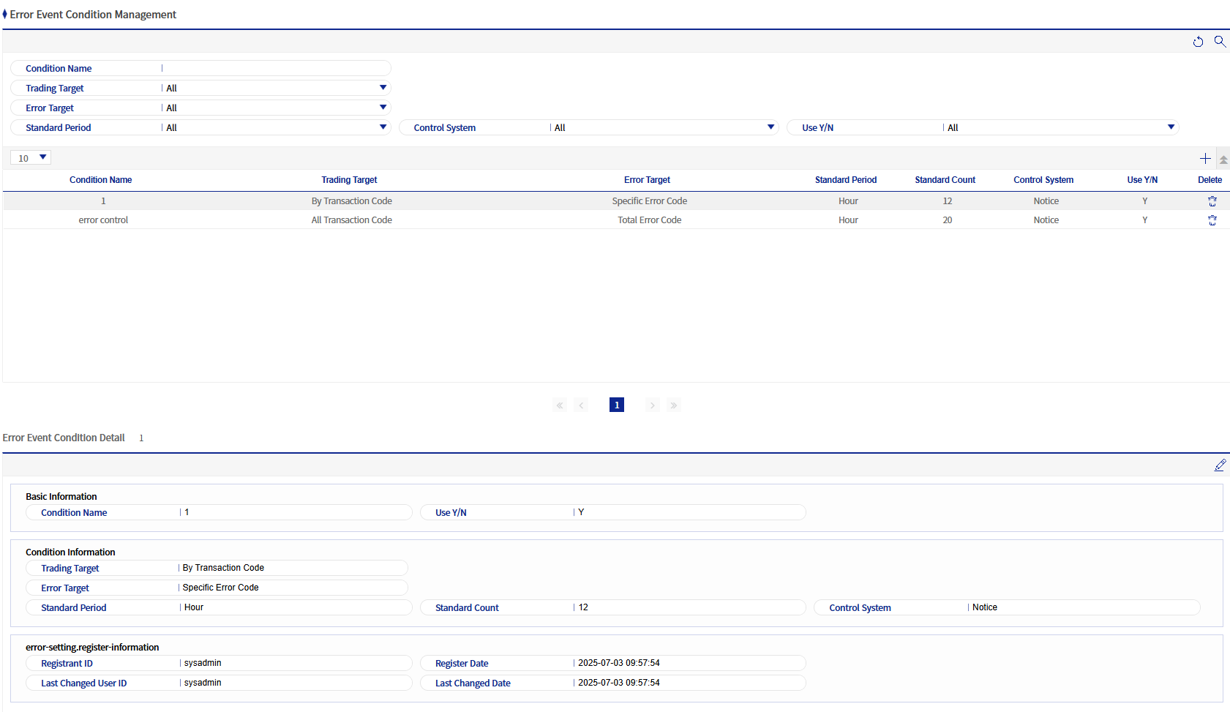
The table below provides detailed descriptions of the fields in Error event condition management.
| Field name | Description | ||
|---|---|---|---|
Condition name |
The name of the management information for specific SQL Codes and F/W error codes. This is the same as the ID for condition event information. |
||
Usage status |
Indicates whether the condition event information is used. |
||
Transaction target |
There are three options: Full transaction code, per transaction code, and specific transaction code. Full transaction code is an option in which, assuming that the Standard count is 10, the condition is satisfied when the total number of errors occurring in each transaction is 10 times or more. Per transaction code is an option in which, assuming that the Standard count is 10, the condition is satisfied when the number of errors occurring in each transaction is 10 times or more. Specific transaction code is an option in which a single specific transaction code is designated, and the condition occurs when the number of errors in that transaction satisfies the Standard count. When the option is specific transaction code, a transaction code must be specified.
|
||
Error target |
There are three options: general error code, specific error code, and specific SQL error code. General error code is an option in which all errors are targeted. Specific error code is an option in which a message ID registered in the Common message is selected, and the number of occurrences is counted when that specific error code occurs. For specific error code, an error code must be specified. Specific SQL error code is an option in which a SQL error code is selected among SQL error codes, and the number of occurrences is counted when that specific SQL error occurs. For specific SQL error code as well, a SQL error code must be specified. |
||
Standard period |
There are two options: time and date. If time is the Standard period, the Standard count is evaluated over a period of 1 hour based on every hour on the hour. If date is the Standard period, the Standard count is evaluated over a period of one day based on 00:00. |
||
Standard count |
Refers to the number of error occurrences during the Standard period. If the Standard period is time and the Standard count is 10 times, it is defined that the condition is satisfied when 10 or more errors occur within 1 hour. |
||
Control method |
There are two options: notification and Transaction control. Notification is a method that sends an alarm when conditions are satisfied, and Transaction control is a method that stops transactions when conditions are satisfied. |